 Written by Patrick Balfe
Tokyo’s waterfront is getting a free, city-scale art exhibition this autumn — with a Yayoi Kusama installation inside a 19th-century gun battery, a French artist living in a giant bottle, and a normally sealed underground car park opened up as a gallery.
What to expect
Tokyo Atlas (styled TOKYO ATLAS) is the flagship exhibition of Arte Tokyo, a new arts festival run by the Tokyo Metropolitan Government.
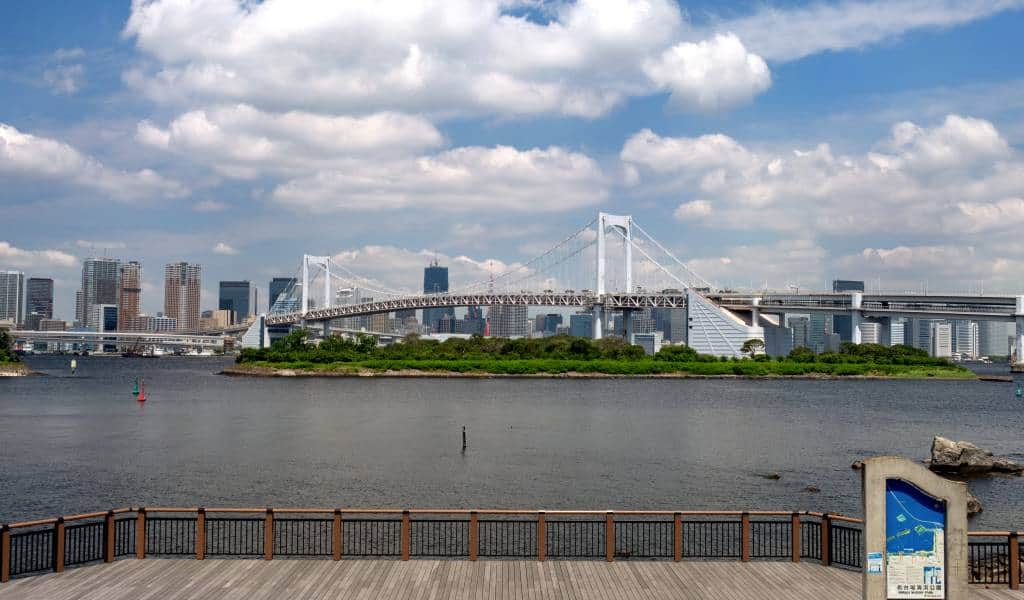
It spreads across three waterfront areas — Odaiba, Aomi, and Tennōzu — putting work by artists from Japan and abroad into public parks, a building atrium, and one very unusual basement.
The two artistic directors split the venues between them. Akira Tatehata takes Daiba Park, Odaiba Marine Park, the Telecom Center Building, and Isle Shinagawa. Akiko Miki handles Aomi Minami Port Park and the space beneath it.
Where to find the art
Daiba Park and Odaiba Marine Park
The headline work is Yayoi Kusama’s Narcissus Garden (1966/2026), joined by Zhao Yao’s Something in the Air (2019), a sound installation by Kenta Ishige, and pieces from Leiko Ikemura, Rui Mizuki, and Kimsooja.
Daiba Park itself is the better story. It is one of the artificial island batteries built in the late Edo period to fire on the foreign ships demanding Japan open its ports — and it never fired a shot. The country opened anyway.
The old earthworks now sit among grass and shrubs, which makes it an unusually atmospheric place to come across a Kusama.
Telecom Center Building
Two Kusama balloon works fill the atrium: Yayoi-chan (2012/2023) and A Bouquet of Love I Saw in the Universe (2021), the latter shown in Japan for the first time. You can look down on them from several floors, and the space changes character between day and night.
Aomi Minami Port Park
Set beside a working container terminal, this venue is the experimental one.
Abraham Poincheval performs La Bouteille (2015–), in which the artist lives inside a giant bottle, and Goat’s Eyes (2020–) — a Tokyo University of the Arts project built around caring for actual goats — sets up something closer to a village on the waterfront.
Yuji Takeoka also shows here.
The underground car park
Beneath the same park runs a 197.5 m underground space that is normally closed to the public. It opens for this exhibition only, with work by Katie Paterson, Ipeh Nur, Han Ishu, Muhannad Shono, and Kawita Vatanajyankur.
Isle Shinagawa and WHAT MUSEUM
Over in Tennōzu, Isle Shinagawa — a former garbage collection site, since rebuilt as a waterfront plaza — hosts a video installation by Yuriko Sasaoka and installation work by Keita Mori.
WHAT MUSEUM runs a related show, Coordinates, featuring emerging artists and curators supported by the Tokyo Metropolitan Government.
Admission
Free, at every venue. The organizers note that a handful of individual programs and exhibitions within the show do charge, but those prices have not been published yet — worth a check on the official site before you set out.
One to know about at WHAT MUSEUM: Coordinates is free, but the museum’s Archi-Depot architectural model collection needs a separate ticket.
Opening hours
Daily except Mondays, 10 a.m.–5 p.m. There are two exceptions: the exhibition opens on Monday, October 12 and Monday, November 23 — both public holidays — and closes the following Tuesday instead.
Coordinates at WHAT MUSEUM has last entry at 4:30 p.m., and stays open until 8 p.m. on October 10 and 11 (last entry 7:30 p.m.).
How to get there
| Venue | Nearest station |
|---|---|
| Daiba Park | Odaiba-kaihinkōen Station (Yurikamome Line), 15-minute walk |
| Odaiba Marine Park | Odaiba-kaihinkōen or Daiba Station (Yurikamome Line), 3-minute walk |
| Telecom Center Building | Telecom Center Station (Yurikamome Line), directly connected |
| Aomi Minami Port Park | Telecom Center Station (Yurikamome Line), 4-minute walk |
| Isle Shinagawa | Tennōzu Isle Station (Tokyo Monorail), 1-minute walk |
| WHAT MUSEUM | Tennōzu Isle Station (Tokyo Monorail), 5-minute walk |
Pro tip: Odaiba and Aomi are close enough to link on foot or with a couple of stops on the Yurikamome Line, but Tennōzu is a separate trip on the Tokyo Monorail or Rinkai Line. Treat it as two half-days rather than one loop.
Organizers may cancel events, alter schedules, or change admission requirements without notice. Always check official sites before heading to an event.