 Written by Greg Lane
While a signature is all you need to authorize a contract in most countries outside East Asia, in Japan — as well as South Korea and to a lesser extent China — a personal seal, known as inkan or hanko in Japanese, is what you’ll need.
What exactly is a hanko?

A hanko/inkan (used interchangeably) is a carved stamp that can be used in any situation where an individual, or an individual on behalf of a company, might otherwise use a signature or initials. Signing contracts, doing your banking (at a bank) or receiving a parcel are just three such cases. The necessity for a hanko and even the type of hanko may vary depending on the situation.
Although the Japanese government is (reportedly) phasing out the use of hanko in many situations, you should expect the seals to stick around for a good few years yet.
There are three common types of hanko used by both individuals and corporations:
- jitsu-in (実印)
- ginko-in (銀行印)
- mitome-in (認印)
Jitsu-in
A jitsu-in (literally meaning “actual/true seal”) is the one you would use when completing certain official procedures. For example, if you’re working as a sole proprietor and you need to sign a contract with a local company, you may need a jitsu-in. The same goes for other situations like setting up a company or buying a house.
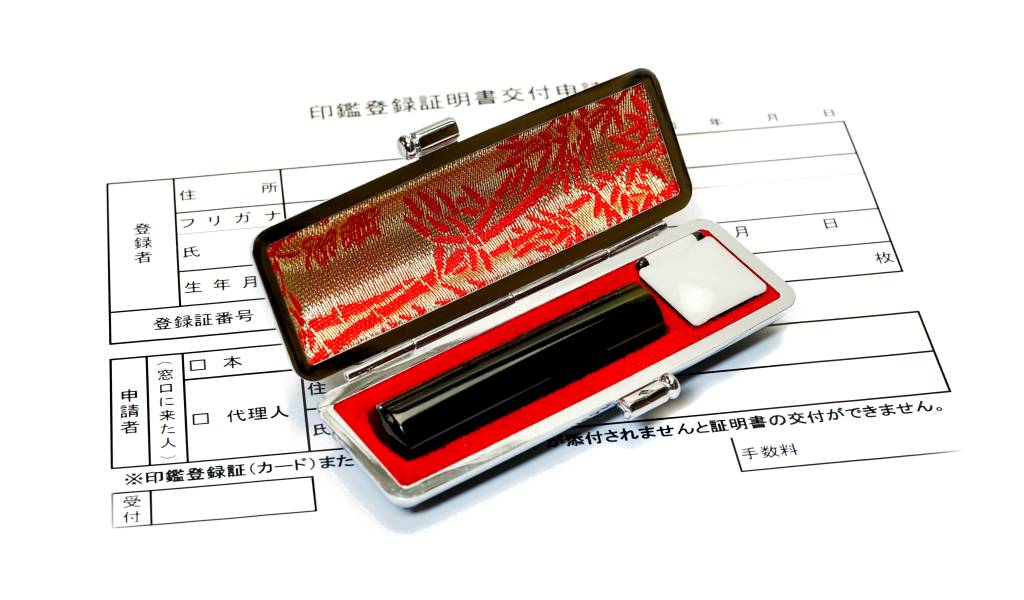
For the jitsu-in to have legal standing, you must register it at your city office. After you’ve registered it, they’ll also issue you with a “inkan card” which will allow you to print certificates of seal registration. When signing an important contract, you’ll often need to impress your seal and provide the certificate to prove that it’s your inkan and that it’s registered.
Ginko-in
A ginko-in is simply a hanko for financial transactions. Instead of registering it with your city office, you just register it with your bank(s). It can be used to withdraw money from your account or sign up for a loan, so you should look after it.
While Japanese patrons are typically required to register a ginko-in when they open a bank account, most banks don’t require it of foreign customers.
One big exception is when you start a company. Since a company isn’t a real person and can’t sign anything, you need to register a ginko-in when you open an account.
Mitome-in
A mitome-in is your regular, everyday hanko which you use for everyday things, like receiving parcels or for stamping on an invoice if you are a freelancer. The mitome-in is not registered anywhere and has no legal standing.
Some people use the same inkan for all three different purposes, but given that the jitsu-in is equivalent to your signature, and it can be easily copied, the less you use it the better.
Also, for almost any situation where a mitome-in is needed, a simple signature will suffice.
Do I really need a hanko?

Most adminstrative processes no longer require a hanko — good ol’ signatures, including electronic signatures, are generally accepted as valid. So, you probably won’t need a hanko for everyday life.
That being said, certain procedures like buying or selling a car, starting a company, selling real estate, or taking out a mortgage on a property often still require a hanko.
Also, a lot of foreign residents get a hanko just because it makes them feel like less of an outsider and they can avoid the teeth-sucking long pause before, “Well, I suppose you can just sign it instead — because you’re a foreigner.”
If you do run into a situation where you require a hanko, the whole process from ordering your inkan to registering it can typically be done in around three days or less, so there’s no rush to get yourself inkan’d up before you actually need it.
What are the rules for a hanko?

The only rule for what can be put on a hanko is that it has to be at least part of your name.
You can use your whole name, your last name only, or even just your first name. You can’t register an inkan with characters that aren’t part of your name (either Latin alphabet or katakana), so if you had your sights on that cool 20-stroke kanji character that sounds a bit like your name to adorn your hanko, it will likely be rejected.
You can have your name on the inkan in either Latin alphabet or in katakana.
If you choose katakana, make sure you have a katakana version of your name registered (this may be recorded on the back of your residence card) at your city office or they may reject the inkan.
For security reasons (to reduce the possibility of counterfeiting), it’s recommended to Japanese people that they use their full name on the hanko.
However, non-Japanese names often contain a lot more characters than your typical 4-to-5-character Japanese moniker, and space is limited, so just your last name or only first and last name might be preferable.
The diameter of the inkan must be between 8 mm and 25 mm. A 25 mm one is a huge hanko, and you may have trouble fitting it on forms that are made for smaller hanko. As a rule, a 13.5 mm diameter hanko can fit two rows of three characters, while a 16.5 mm diameter hanko can fit two rows of five characters. If you go to a small neighborhood hanko shop, they might be able to do some magic and squeeze a lot more on to the same space.
So what’s the process, and how much does it cost?

Step one is to order your hanko from a hankoya (hanko shop). Hankoya used to be a fixture of every neighborhood of Japan, but with the proliferation of chains and online shopping, they are now more difficult to find than they used to be.
Cheapo options
If you’re just looking for an inexpensive hanko as a personal souvenir or as a gift, you can find a huge assortment of standardized hanko — with common Japanese names, or a single hiragana/katakana/kanji symbol — at most 100 yen shops or stationery stores.
Keep in mind that these hanko are quite small and not unique (some with words like “peace” or “dragon”), so they will not be accepted for official purposes (like the jitsu-in or ginkou-in). They will be treated as general seals (mitome-in).
Ordering hanko in person
Hankoya 21
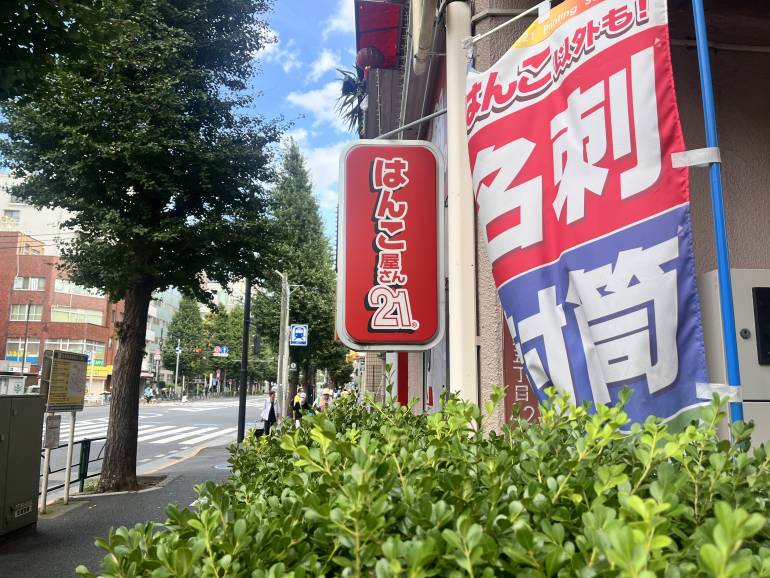
Hankoya 21 is a popular hanko chain with locations across Japan — you’ll find one in nearly every neighborhood in Tokyo.
We went to one of their locations in the Shinjuku area in August 2026. The staff had a pocket translator on hand, which made communication more or less seamless. We can’t guarantee that every location will have this service at all times, but at branches in areas such as Ueno or Asakusa that are popular with travellers, there’s a decent chance you’ll be able to get assistance in English, and potentially Mandarin or Korean as well.
After selecting the jitsu-in option, the staff asked to see Japanese government-issued ID — this can feel invasive, but it’s to check the correct spelling and length of the name to engrave.
From there, they recommended a hanko size based on how many characters needed to fit on the seal. Prices go up with the size, so longer names can cost a little more. In our case, fitting a 12-character name onto a 12 mm seal came to ¥3,300 for same-day service, or ¥2,750 if we were happy to pick it up the following day.
It’s worth listening to the staff’s advice on fonts, too. Simple, blocky lettering can be the safer choice, since narrow or heavily slanted characters may leave thinner, more fragile sections in the finished seal.
There was a fairly wide choice of materials, including black plastic, colored plastic, black buffalo horn and fragrant Japanese cedarwood. The staff told us titanium is one of the most popular choices thanks to its durability, although it takes around one to two weeks to prepare.
You can also add a case for ¥1,980, which comes with a small pad of the customary red ink inside. Buying one at the hanko shop isn’t necessary, although you get a small discount if you order it together with the seal. Cases are easy enough to find elsewhere, and the red ink can be picked up separately at stationery shops, so there’s no need to buy the whole package on the spot.
Don Quijote

Don Quijote boasts a fancy-schmancy (not really) hanko box—a machine that will engrave your seal in a few minutes. It’s generally stationed near the check-out area, but ask for it if you can’t see it.
These hanko machines are more likely found at “regular” Don Quijote stores in major cities, rather than at the “Mega Don Quijote” locations in the ‘burbs and countryside (although the name would suggest otherwise).
The interface is in Japanese, but it’s relatively easy and intuitive to use it (don’t stress about all the kanji: green button means proceed, red means back). You can select, move, resize and change the font of whatever you want to write, mixing kanji, katakana and the Latin alphabet as you like.
The touchscreen is not perfect, but with a bit of patience you can get really great results. The price starts from around ¥1,000, and goes up with better quality materials and larger size.
Ok, it’s a lot more than the 100-yen ones, but the better quality and customization make these hanko a lot more useful!
Online options

Online hankoya include hankoya.com, Hanko-Store.com and office supplies giant Askul. Use the Google Translate extension to view the website in the language of your choice.
Just like in person, when ordering, you start by choosing the material. Prices start at around ¥3,980 for the smallest, cheapest hanko and go up into the tens of thousands of yen if you want to rock a hanko made from premium materials like silver or precious stones.
Hankoya.com clearly states that they do not use elephant or mammoth ivory, with a message on the site regretfully informing hanko shoppers that the material is no longer available due to that pesky CITES. Sadly, a dirty secret of the inkan industry in Japan is that there are still shops advertising and selling inkan made from elephant ivory.
After choosing the (not ivory) material, you select the size and then the typeface for the hanko.
Often, curly, almost illegible traditional characters which blend into each other are used on hanko, but this doesn’t look nearly as cool with katakana or Latin alphabets.
Next, you input the characters as you want them to appear on the inkan. You can choose whether they send you a draft design for review before the inkan is made.
Lastly, choose the payment method. Those without a Japanese credit card can rejoice as there is a payment on delivery option.
Registering your hanko

Once you have your hanko, the next step — assuming you need it to be a jitsu-in — is to register it at your local city or ward office.
Head to the inkan registration counter with your hanko and residence card or My Number card and tell the staff you want to do inkan tōroku (yes, there’s a special section). You’ll be given a fairly simple form asking for details including your birthday and address, along with a space for an impression of the hanko. At the office we visited, there was an ink pad ready to use, so you don’t need to bring your own.
After handing the form over, you wait while the staff checks everything. They’ll also make two or three impressions of the hanko themselves before completing the registration.
Then comes a little more waiting, after which you’ll be given an inkan card. This card is what you’ll use when you need to obtain an official certificate proving that the hanko is registered to you.
The staff may ask whether you want an inkan registration certificate there and then, but unless you actually need one for a contract or other procedure, there’s no particular reason to get one in advance.
Finally, pay ¥50 to receive the inkan card and you’re done. Note that the fee may vary.
Frequently asked questions
Can foreigners register a hanko in Japan?
Yes. If you are a foreign resident aged 15+, you can register a hanko, as long as it meets the requirements, at your local ward/city office.
Can I use my name in English on a hanko?
Yes! In fact, if you have no registered an official katakana spelling for your name, this may be your only option.
What happens to my inkan card if I move?
The rules may vary depending on your ward/city, so make sure to check.
At the ward office we visited, we were told there’s no need to return the card upon moving. The inkan registration is cancelled when you move out of the municipality, and you’ll need to register the hanko again with your new city or ward office if you still need a registered seal.
Oh crap, I done lost my hanko, what do I do now?
Because your hanko has the power of a signature, if it’s stolen, you should report it to the police and cancel the inkan at your city office. To cancel your inkan, you’ll need either your residence card or your “My Number” card as well as your inkan card. There is no fee for canceling your inkan.
If you’ve lost your inkan (a surprisingly easy thing to do!), then you should order a new one before visiting your city office. At the city office, they’ll ask you to fill out a form to cancel your old inkan and then fill out another form to register your new inkan. The inkan card is connected to your hanko, so they’ll need to reissue your inkan card for which there is a fee of ¥50 or more, depending on the ward/city office.
This also highlights the benefit of not using the same hanko for your banking. If you’ve registered your lost hanko at the bank, you’ll have to go there and register your new one — at each financial institution. Also a good argument for sticking with your signature!
Article first published in August, 2016. Last updated in August, 2026.